EPF 2026: The Important Changes and How They Affect Employers and Employees
The new EPF scheme has introduced some big changes to the 1952 version. But these changes are essentially operational and implementational. The fundamental purpose still remains the same: retirement savings.
The new scheme has shifted provident fund administration to the Code on Social Security, 2020, from the Employees' Provident Funds and Miscellaneous Provisions Act, 1952. This means several social security laws like PF, ESI, Gratuity, etc. have been merged together for simplified compliance. The Employees' Provident Fund Organisation (EPFO) still administers PFs, but now under the authority of the new Code rather than the 1952 Act.
We'll discuss the main changes in the scheme and how it affects employers and employees.
The Essential Changes in EPF Scheme 2026
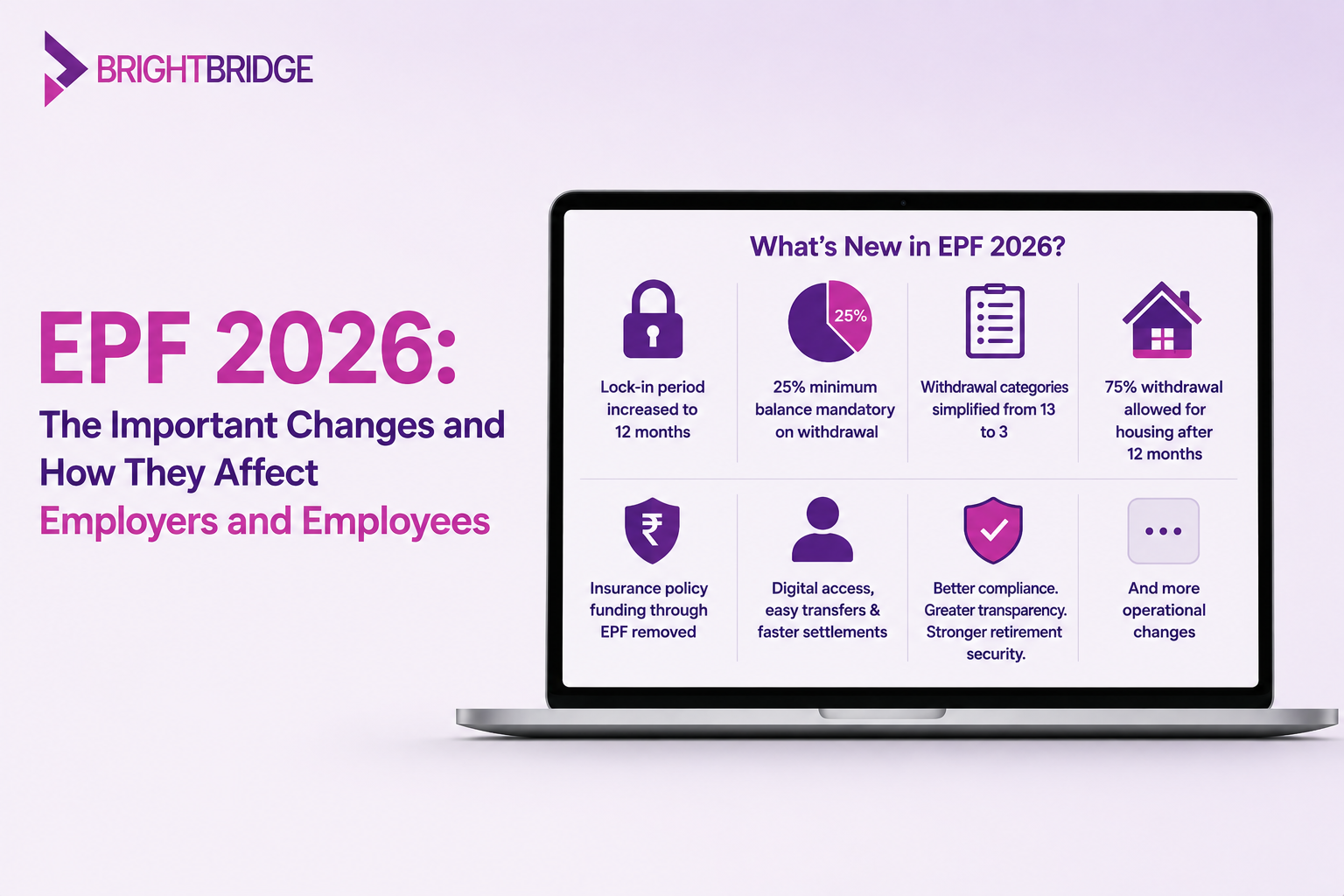
- Lock-in period for full withdrawal increased: The first big change that concerns the employees is that the lock-in period for withdrawal has increased from 2 months to 12 months. That is, as per the new scheme, you can't withdraw 100% of your EPF fund before 12 months of unemployment.
- Minimum balance enforced on withdrawal: A 25% minimum balance has been made mandatory for withdrawal from EPF funds. This means the available funds to withdraw and the percentage calculation will be done now after deducting this minimum 25% from the total fund.
- Withdrawal categories simplified: The EPF withdrawal categories have been simplified into 3 from 13 to reduce confusion: Essential needs, Housing needs and special circumstances. The requisite time of membership for withdrawal has been eased from 5 years to 12 months, and the claim settlement timeline has also been reduced from 30 to 20 days.
- Revised Withdrawal Eligibility: Once resigned or retired, members can withdraw 75% of their PF balance right away and 100% after 12 months. For female EPF holders, the eligible withdrawal is 100% of the EPF balance after unemployment.
- Housing withdrawal Flexibility: 75% of the EPF balance can be withdrawn for housing uses after completing 12 months of EPF membership.
- Provision for insurance policy funding through EPF is removed: EPF balances can no longer be used to purchase new life insurance policies, though premium payments for existing policies may still be allowed.
- Voluntary employer contribution above minimum: Employees can voluntarily increase or decrease contribution amounts above the 12% cut-off. But employers are no longer obliged to match employee contributions outside the minimum contribution.
- Nominee updation mandatory: Nominations must be updated in the new scheme as nominations under the 1952 scheme won't be valid anymore.
- Centralised digital access to PF funds: Transfer of EPF for employees changing jobs has been made easy by enabling a digital EPF transfer process that can be done by Aadhaar-based transfers or digital transfer request submission.
- EPF responsibility falls on the main hirer: With the introduction of the “Principal Employer” concept in the new EPF, if a third-party contractor fails to deposit PF contributions, the hiring company (the principal employer) is now legally responsible for employees' EPF contribution.
- Employees' Enrolment Campaign: A special campaign has been introduced that lets employers add employees who've joined between April 1, 2009, and March 31, 2026 but previously were not added to EPF while also waiving their contribution if it hasn't been deducted before. It's valid till 31st October, 2026.
- VISHWAS: A special provision has been introduced to handle damages for defaults in the payment of contributions for periods before June 14, 2024.
- AMNESTY: It's a six-month provision allowing establishments operating unnotified Provident Fund Trusts to apply for retrospective exemption and regularisation.
What Has Not Changed
- The minimum contribution from employees and employers and the wage ceiling remain 12% and ₹15,000 respectively.
- The existing EPF holders do not need to open a new account. Their UANs (Universal Account Numbers), memberships, and interest earned will continue without any effect.
How This Affects Employers
- Employers don't have to match employee EPF contributions above the statutory minimum.
- Digital systems will help maintain compliance more efficiently.
- A smoother digital process will help employees to execute processes by themselves, which will reduce workload on HRs.
- Employers will need stronger payroll and compliance processes as stricter penalties have been decided upon failure to fulfil regulations, like a late fee of ₹500 per day will be levied for delays in filing mandatory returns.
- Employers will need stronger due diligence in appointing third-party entities to hire contract workers as the ultimate liability of EPF contribution will rest with the principal employer.
- Employers have also been allowed relaxations and regularisation scopes in retrospect through Employees' Enrolment Campaign, Vishwas and Amnesty where they can enroll employees who have been previously missed, secure relief on damages for formerly occurred contribution defaults, and get an opportunity to apply for retrospective exemption and regularisation for an unnotified provident fund trust.
How This Affects Employees
- The digitisation of processes like automated claim processing of online claims submitted, and more new services getting added slowly, will help employees move faster and more smoothly through the system without getting stuck in paperwork.
- Claim settlement time has been enforced to 3 days, subject to eligibility and updated paperwork, with a penalty of 12% on settlement in case of delay by an EPFO commissioner. This assures employees get quicker access to funds during medical emergencies, unemployment and other financial needs.
- Employees can now smoothly access their EPF regardless of job changes through Aadhaar-based or digital requests.
- Contract workers' EPFs are now safeguarded through principal employer policy.
- The introduction of minimum balance and an extended lock-in time for withdrawal means employees' retirement fund will continue accumulating interest over that period and they'll have savings for post-retirement.
The Next Steps for Employers
Initial Setup & Registration
- File Form V (Consolidated Return) within 15 days of the scheme becoming applicable. File a Nil return if there are no eligible employees.
- Submit Form VI (Ownership Return) with details of directors, partners, managers, or occupiers. Display it at the establishment and on the company website.
- File Form VIII for branch or department details.
- File Form IX to authorize up to five employees to sign EPFO documents and returns.
Monthly Compliance
- Submit Electronic Challan-cum-Return (Form VII) and deposit PF contributions within 15 days after the end of each month.
- Upload employee updates, including new joiners, transfers, and exits, within 15 days after month-end.
- Help employees generate their UAN and access their e-Passbook.
For Employers Engaging Contractors
- Register contractors through Form X.
- Ensure contractors submit Form XI (monthly recovery statement) within 10 days after month-end.
- File Form XII (monthly consolidated statement of contractor contributions) within 20 days after month-end.
Update Payroll Software
Finally, employers should update the payroll software they currently use, to align with EPF requirements.
The new EPF scheme is an attempt to attain better systematic management of the processes corresponding to the current job market through digital access, stricter compliance and effective implementation. The rules are simplified, and the processes are digitised, suited for faster and smoother adoption. Companies should start implementing the new regulations and communicate with employees their responsibilities, like KYC completion and nominee updation, to avoid any future regulatory breach and penalties.
Frequently Asked Questions
Do the recent EPF changes apply to existing members?
Has the statutory EPF contribution changed?
Can I withdraw my entire EPF balance after completing one year of service?
Will every EPF claim now be processed within a few days?
Can incomplete KYC still delay an EPF claim?
Are UPI-based EPF withdrawals available today?
Do employers need to modify their existing EPF contribution process?
What should employees do before submitting an EPF withdrawal application?
What could still delay an EPF claim despite the recent reforms?
Do the reforms change the final EPF settlement process after retirement or resignation?
Do these changes affect employees changing jobs?
Are all the announced EPF reforms currently operational?
Has the EPF salary ceiling changed under the recent reforms?
Will my monthly take-home salary change because of these reforms?
Where can employees obtain accurate information regarding the latest EPF changes?
Disclaimer: This article is intended for informational purposes only and does not constitute legal, financial or regulatory advice. Readers are advised to consult a qualified professional before taking any action based on the contents of this post.