Issuance of Overseas ESOPs: Global Rewards, Indian Regulations
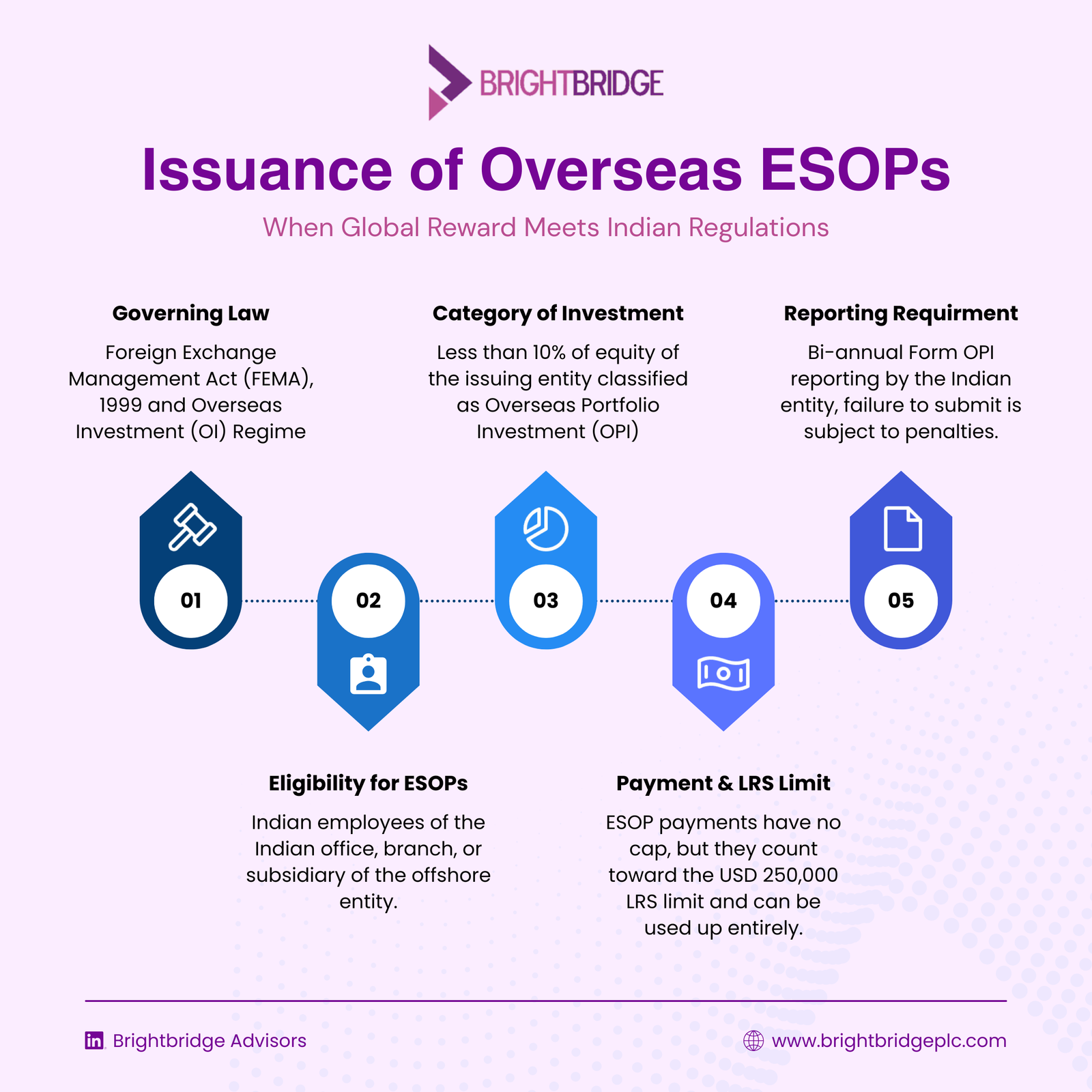
The Foreign Exchange Management Act, 1999 and the rules issued thereunder including the Foreign Exchange Management (Overseas Investment) Rules, 2022, Regulations, 2022, and Directions, 2022 (collectively, the "OI Regime") govern the ESOPs granted by offshore entities to Indian resident employees employed with the Indian group entity.
Offshore Entities Granting ESOPs
The OI Rules permit the grant of ESOPs by offshore entities to Indian resident employees, provided that two key conditions are met:
- 1The individuals are employees or directors of the Indian office, branch, or subsidiary of such offshore entity or an Indian entity in which the offshore entity holds direct or indirect equity interests.
- 2The ESOPs are offered by the issuing offshore entity "globally on a uniform basis."
Categorization of ESOP Investment
The OI Rules provide that Indian employees may acquire shares or similar equity interests of permissible offshore entities via an ESOP Plan. Key conditions include:
- Overseas investment by Indian employees should be less than 10% of the total equity capital (whether listed or unlisted) of the issuing entity, without acquisition of any control.
- This is classified as Overseas Portfolio Investment (OPI).
- The OPI route allows investments by Indian resident individuals in offshore entities engaged in "financial sector activity."
Investment Amounts and LRS Limits
No Cap on Consideration Amount
There is no cap on the consideration amount that can be remitted by an Indian employee for acquisition of ESOP shares. However, any such remittance will be counted towards the overseas investment cap under the Liberalized Remittance Scheme (LRS) issued by the RBI currently at USD 250,000 per financial year.
Remittance Above USD 250,000
Any remittance above USD 250,000 is permitted, but the individual's LRS limit for that financial year will stand exhausted. Such individuals may not be able to make any other overseas investments (other than via the ESOP route) for that particular financial year.
Permissible Modes of Payment
To subscribe to ESOP shares upon exercise, the Indian employee can remit the consideration amount directly to the issuing entity through two permissible modes:
- 1Ordinary banking channels standard remittance through an authorised dealer bank.
- 2Funds held in a FEMA-compliant account maintained in accordance with the Foreign Exchange Management Act, 1999.
Reporting for Acquisition of ESOP Shares
Employer's Obligation
The Indian employer is required to file a bi-annual report in Form OPI within sixty days from the relevant half-year end (i.e., March or September of a given financial year) in which the exercise is made through the Indian employer's AD Bank.
Employee Exemption
The Indian employee acquiring ESOP shares continues to remain exempt from the requirement to make any separate filings.
Form OPI Required Details
- ESOP investment amount
- Details of the ESOP shares being acquired
- Number of Indian employees acquiring the ESOP shares
- Details of the issuing entity
Failure to Report
Late Submission Fee (Within 3 Years)
Failure to report within the stipulated timeline attracts a Late Submission Fee (LSF) of ₹7,500 per delayed filing, where the filing is finally made within three years from the due date.
Compounding Penalty (Beyond 3 Years)
If the delay exceeds three years, a compounding application must be filed with the RBI. The RBI may impose a compounding penalty of ₹10,000 per delayed filing plus a penalty of up to ₹2,00,000 depending on the amount and nature of the contravention involved.
Frequently Asked Questions (FAQs)
Can an offshore company grant ESOPs to Indian employees?
What is the LRS limit for ESOP remittances?
Who is responsible for filing Form OPI employer or employee?
Is reporting required for cashless exercise of ESOPs?
What is the penalty for not filing Form OPI on time?
What does "globally on a uniform basis" mean for ESOPs?
Disclaimer: This article is intended for informational purposes only and does not constitute legal or regulatory advice. Readers are advised to consult a qualified professional before taking any action based on the contents of this post. Information is current as of December 2025.